Saturday, September 29, 2007

Enjoy the Show!


Take a peek at Suture for a Living and enjoy the carnival at SurgExperiences 105. A fun presentation by Dr. RL Bates.

Mistaken Identity?


For months now I have been referring to Suture for a Living's author as ribates! It finally dawned on me one day that this isn't her title. What follows is my apology!


I am a bit dyslexic. I remember the correct numbers, but in the wrong sequence, I always have to pause and do an air sketching before I write the letters d or b, or I will invariably place the half circle on the wrong side of the stalk. I even type dyslexic, you is usually yuo, and is adn, etc.
And..... I read things incorrectly over and over again until one day, something makes me concentrate a little harder, and I see the written word in an entirely different context, sporting a whole new meaning. Such is the case with your name.
Since the beginning, I have read your name as ribates, I have often wondered what does ribates mean? Hmmm....must be Latin. I pronounce it ree-bah-tees in my dehydrated brain. Even googled it hoping for enlightenment but got a hodgepodge of results.
It's a wonder the spelling/grammar police never corrected me! Or, no one even noticed, except me, finally, some three months later.

(In the voice of the Pathological Liar) http://videos.matchdoctor.com/4132/Jon_Lovitz_-_The_Pathological_Liar.html
Sorry for the past er...uhm....typos. Yeah, that's it......typos, that's what they are. Typos, that's the ticket.

R L Bates, oh now I get it! So much easier to pronounce and it makes sense!

Sunday, September 23, 2007

Tagged!?


Yikes! I've been tagged by Karen of Up the Dose. I'm pretty sure I can come up with 8 random(?) facts about myself, but I'm not so sure I can come up with 8 fellow bloggers to tag who haven't already been tagged. If I tag you and you've already been there, done that, I apologize in advance but maybe you could humor me!

The rules:
1. Post these rules before you give your facts.
2. List 8 random facts about yourself.
3. At the end of your post, choose (tag) 8 people and list their names, linking to them.
4. Leave a comment on their blog, letting them know they've been tagged.
The facts:
1. I once was a weapons qualified, gun toting, armoured truck driving, on-call, ATM money restocking guard for a small, private company.
2. The longer I work in health care, the more obsessive my OCD becomes. I am now questioning how sanitary it is to reuse those plastic produce bags (I'm a big recycler) after they have had "dirty" produce in them. In a restaurant, my silverware either remains on the napkin, or rests on the edge of the plate. If one touches the table, I won't use it.
3. I eat salad with a spoon. BTW, I could fill up a whole page with food rituals.
4. A friend, and at the time, boss, helped me build a home-made camper shell out of plywood for the back of my very old F-250. I still own that truck. (Bless you and yours Tom H.) I then lived in it one very cold winter in the parking lot of the truck stop where I used to work. I've also lived in a late 70's model Toyota Corolla with a dog, during a very cold winter at a truck stop in Midland, Texas. I have since discovered the pleasures of indoor heat and plumbing.
5. I used to love to fly. Within several years after airline deregulation, I developed a fear of flying. I do not consider this a phobia as phobias are based on unfounded or unreasonable fears.
6. The most inspiring message I have seen/heard since......? This video, thanks to Kevin, M.D. , featuring a lecture from Professor Randy Pausch. I take away a renewed determination to become a Physician Assistant.
"The brick walls are there for a reason. The brick walls are not there to keep us out." " The brick walls are there to stop the people who don't really want it badly enough."
7. I live with a dog, a cat, and two horses. My cat snores and my dog doesn't. I'm not sure about the horses. The cat says I also snore. The cat is a liar.
8. I think Halloween is a very scary holiday. I find it unnerving when I see adults driving around in the daylight in full costume presumably for some holiday celebration at work. If we see someone blatantly hiding their identity any other day of the year, say in a ski mask or the mask of a dead president, everyone would be highly suspicious but on Halloween all bets are off! And yes, before you ask, clowns also freak me out a little.
Well, that was the easy part. NOT. Now for eight people to tag.
First, I think I will tag WhiteCoat. I have recently discovered his, or her blog (I am never too sure anymore thanks to #1 Dinosaur !). This is well written and humorous and on my list of daily blog rounds.
Next, ER Tech Dude. Also newly discovered to me.
Number three, Jeffrey at Monash. Thanks for promoting med blogs through Surgexperiences.
Half way there. Rob and his distracible mind now that he seems to have landed permanently in his new URL.
Number five. Ten out of Ten Don't know him well and he may not play, but what the heck.
Ribates. She seems like such a gentle soul. I would love to know more about her.
Two to go....I would love to tag Scalpel but he already bared all as Dr. September, #1 Dinosaur, also interviewed as Dr. August, the interviewee, Addicted to Medblogs, recently meme'd.
I stumbled across this blog and instantly enjoyed it. I hope she has time to respond, we'll be patient. Welcome Surgeon Girl.
And now, number eight. I have procrastinated long enough. He can be cynical and sarcastic, caustic at times, clever and cunning, he tells it like it is, holds nothing back, and he both fascinates and terrifies me. Like a moth drawn to the flame, a bug to the bug zapper, Britney to rehab, I dare to tag 911 Doc.

Thursday, September 20, 2007

Stomped, Beat-up and Whooped Day 2. Mon.


I arrived home at approximately 0340 A.M. I have some animals to take care of. The horses I will feed on the way out again. My dog is 14 years old, has hip dysplasia, and is occasionally incontinent of stool. Although he has a doggie door the whole time I am gone, I always let him out again just before bed. Out goes the dog. I get bedtime treats ready for he and the cat. I am starving, but don't want to take time to eat. I let the dog back in. I have prepared myself for sleep in his absence. Treats having been dispensed, I set alarms (it routinely takes several to wake me) turn off the light, and try to sleep fast.

I always drift off to sleep with the television "watching me" as my step brother says. With only a couple of hours sleep possible, I decide that the TV will only distract me so I leave it off. The dog picks this quiet time to take his bath. Lick, lick, lick lick, lick. It's driving me nuts! I don't want to get up. I try a pillow over my head. Ick, ick, ick. I tap the dog on the head and yell "Go to bed!" This used to work when my dog could hear. He looks at me for a moment and lays his head down. I start to drift off.....wait, what is that ....that smell? DOG! You just came in! I get up and hoist my dog with the bad hips up to a standing position (this expedites the transition). After he has stabilized, we head to the front door and out he goes again while I clean up his latest oops. By time I am done cleaning up, and the dog and I are back in our respective beds, I am afraid to look at the clock. I'm sure at least an hour has passed since I got home.

My alarm goes off at 0600. I have 45 minutes to get ready. I brew a cup of coffee, jump in and out of the shower, pull my hair up, skip the make-up, take care of the animals feeling guilty that I haven't had any quality time with the old dog.

"It's okay." I say to the dog.

"I'll be done by 5:00 this afternoon and I'm heading straight home."

JINX!
I pull out of the driveway at 0645. The first case of the day is a revision total hip. The primary total hip has failed prematurely. As we begin exposure, there is some suspicious looking soft tissue we dissect out of the joint capsule and send it off for permanent pathology. Having achieved exposure, the surgeon attempts to remove the old (cemented!) prosthesis, and it slides right out of the femoral canal with little or no prompting. The greater trochanter, which has previously been cerclaged, has never healed. The femur has been fractured below the level of the old prosthesis at some point in time since the original operation. The surgeon asks the circulating nurse to send word to the next patient that their surgery will be bumped back to 1100 AM.

We must remove the old acetabular prosthesis, and ream to fit a new one. The cup will be non-cemented, but will be affixed to the pelvis with screws. All old cement must be chiseled from the femoral canal, then it will be reamed for it's new prosthesis. Revision arthroplasties can be tediously challenging. Osteoporotic bone and other disease processes can further add to the challenge. This case proved no different. Without going into specifics (I have blogahippaphobia!), we wheeled the patient into recovery some five hours after we started.

One down, three to go. Second case of the day, revision knee. This patient will have the uni compartmental knee prosthetics removed and be converted to a total knee. A much healthier patient with much better bone. The case goes very well and two hours after we enter the OR, the patient is getting post-op films done in recovery. While room turnovers are usually very quick at this hospital, it is now after 1500 and the fully staffed day shift is going home. There is no extra staff. Some of the instruments need to be washed and flash sterilized for the next case which also adds to turnover time. Our third patient enters the OR just past 1600.


Next case, primary total knee. Straight forward, no revision. Only downfall, a pair of large thighs on someone weighing 300 plus pounds. As the assistant, I stand on the opposite side of the bed as the surgeon. Therefore, I am leaning across the bed while holding retractors, the leg, drilling pilot holes, suctioning, etc. Normally this isn't a problem. I hardly notice in fact. But add two hours of trying to hold the non-operative extra large leg from rolling off the edge of the narrow OR bed with my lap (why we didn't tape it, I don't know), and constantly reigning in the operative leg which wants to tilt out at a canted angle to the bed, and it spells fatigue.

Someone blogged about the fact that the back of your knees begin to ache during surgery. It is very true, at times I've walked away from the operating room stiff-legged until the elasticity returned to my tendons and muscles. I walked (hobbled) away from this case with my knees and lumbar spine screaming. By 1900 I finally broke down and took two naproxen sodium tablets.

The final case of the day! Another 45 minute room turn over but it felt good to sit for a few moments. The last patient of the day is also the thinnest. Thin patients make for much easier surgery almost without exception. Exposure is easier, manipulating the leg (or tissue) is easier, transferring the patient to the bed is easier, etc. Although the procedure is moving right along without complication, the room is oddly quiet. Extraneous chatter has slowed to an occasional trickle. Everyone, it seems, is tired. The spell is broken when the time to mix cement (there's nothin' better than the smell of polymethylmetacrylate in the morning! (or evening) has come. I irrigate the joint while we wait. Implants in, cement hardened, drain placed, we begin closing the wound. The wet of the irrigation and the cold of the room seem to have paired up to stiffen the joints of my fingers and knuckles through two pair of thick gloves. I awkwardly tie suture. It feels as is I am trying to tie with mittens on. Finally we staple skin and I apply the dressings.

I sit for a minute in recovery with the surgeon I have just spent the last 14 hours with. He tells me that the last patient had almost decided he was too tired to have surgery because it was getting late. We share a chuckle over this. He also shares that the first patient of the day is doing fine.

With my back pain down to a dull roar and hands feeling as if they belong to an arthritic 80 year old, I change into my street clothes and head home at 2230 hrs. In the last 27 hours I've had a one hour nap and two hours commute time. The rest has been spent assisting in orthopaedic surgery.

Thank goodness I have no cases scheduled for Tuesday. I spend the day recuperating with sore muscles and stiff hands. General trauma surgery has never left me feeling this wimpy, but back to back days of orthopaedics has left me stomped, beat-up, and whooped!

Tuesday, September 18, 2007

Stomped, Beat up and Whooped! Day 1, Sun.


I usually blog about general surgery or trauma. These are my first loves, but I also assist on a fair amount of ortho cases. There are, in fact, two orthopaedic surgeons who keeps me alive. They both use me on a regular basis. I am often their first resource for assistance. In turn, I take ortho trauma call with them.

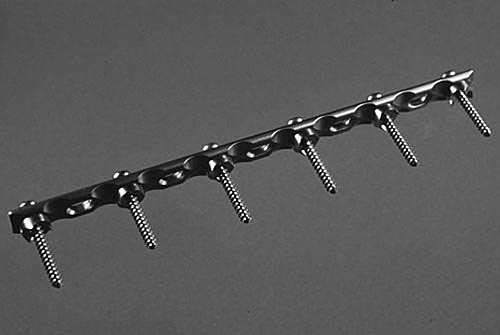
On Sunday all was quiet until 1600. First case of the night, closed femoral shaft fracture. Procedure, IM nail. This is a minimally invasive technique compared to plating and is conducive to faster healing with less risk of complications. Here is the condensed version of the procedure. A short guide wire is passed to below the lesser trochanter and into the medullary canal. A proximal reamer is then passed over the guide wire. Short guide wire removed, a longer ball-tipped guide wire is then passed down the canal, past the fracture site, and to the distal femoral condyles (or just above the knee). Reamers graduating in size are then passed over the guide wire, down the canal to the knee until you get satisfactory "chatter" which is the reamer contacting the hard cortical bone of the femur. The size of your reaming correlates with the size of your IM nail. The nail is loaded on a jig and then passed over the guide rod until it is seated at the satisfactory depth. The guide rod is removed. If rotation and fracture reduction is good, the nail is "locked" in place with femoral neck screws and /or distal femur screws. Sounds pretty simple huh?

Well, it is. Or at least it can be. The hard part is reducing the fracture so that all of the necessary equipment passes down the proximal femur, through the fx site, and continues in the medullary canal of the distal femur. If you don't check AP and lateral c-arm images, you can be fooled into thinking you are in the canal when in fact you are too anterior or posterior, too medial or lateral. If you are the one advancing the ball-tipped guide, it is amazing how you can tell by feel if you are "in" or not. If you are the one down at the calf pulling traction on the leg with one arm and trying to align the fractured parts by pushing on the thigh at strategic spots with a metal mallet in your other hand (so you don't irradiate your own hand) it is amazing at how physically taxing this can be. I believe this is where the saying "It's better to be lucky than good" originated. No matter how strong you are, or how well the alignment of the fracture looks on one view, you can be miles off on the other view, and unless there is no muscle at all, even a middle-aged woman's thigh is still very resistant to lengthening. If anaesthesia doesn't have the patient totally relaxed (as in muscle relaxation) you can just about forget it. If you are lucky. however, you will achieve alignment and pass the guide wire on the first try. We were not lucky this night.

By 1930 with the first patient resting soundly in recovery, we began the second case of the evening. ORIF of an open wrist fx on somebody's nonagenarian, great, great, great grandma. She reminded me of my grandmother, who is two years older the she. What a sweet woman with a sharp mind. Oh yes, and so was our patient.

Third case began at close to 10 pm. Another femoral shaft fx, another IM nail. If a middle-aged females' thigh is hard to manipulate (keep it clean), imagine a strapping young man with a heavily muscled thigh as big around as a middle aged woman. Luck would definitely not be on our side yet again. The orthopaedic surgeon, being a man and all, decided that he would be much more capable of distracting this massive thigh and thus, reducing the fx. The assistant, being myself and female, decided that I was smart enough to agree. This means that I get to advance the ball-tipped guide wire, ream over the guide wire and advance the nail while he holds traction. I also get to call the shots. I mean literally. When I need to see if the guide wire passed through the fx site, I get to say "Shot" to the rad tech, who then pushes the button on the c-arm and shows us where the guide wire lays. It's a position I'm not used to and I advance the guide wire a time or two waiting for the surgeon to say "x-ray" and realize that he is sweating and grunting and trying to remain motionless while holding traction, waiting for me to say "Shot." It brings a small and very fleeting smile to my lips.

Several failed attempts later, I call for the "F" tool. The F-tool is a flat radiopaque bar with several threaded holes machined in it. Three round pegs come separately and may be threaded into the bar, one at the distal hole, and the second peg at various positions forming the letter "F". (You thought F stood for something else, didn't you?). The two pegs forming the F are placed on either side of the thigh and pushing the handle in a certain direction allows for some extra leverage to bring the two fractured ends together.

The F-tool helps to an extent, but the only one we have to work with is for pediatric sized femurs. The pegs are much shorter than this massive thigh is deep, so reduction continues to elude us. We finally think that we are in in the AP view so the surgeon call for a lateral. Oh! It is sooo close! We are out of the distal canal medially. An adjustment to the F-tool position, a large bump strategically placed under the thigh, more grunting, sweating and an occasional F-bomb (this time the F does stand for what you think) and we're in! What a battle! It is almost midnight before our strapping young man is sleeping comfortably in recovery.

Somewhere around 2300 the surgeon's pager had finally stopped it's incessant beep, beep,beeping. So far, so good. On to what looks like the final case of the evening, or morning.

In surgery things seem to come in three's. Three lap appy's, three stabbings, three AAA's. Orthopaedic surgery is no different. Our third patient and femoral IM nail, rolls into the O.R. at approximately 0030 hrs. We are on our second Anaesthesiologist. It takes only two tries to get the guide rod to pass.

Anaesthesia says "Are you showing off?"

"We've had lots of practice!" The surgeon and I reply in unison.

While it feels like we are moving much quicker on this case, it is still almost 0230 before I accompany the patient to recovery.

Time to unwind a bit. The surgeon catches up on dictation. I catch up on my paperwork and chomp down an apple. We chat a bit about the night and what his O.R. schedule looks like for Wednesday. I bid him farewell at 0310 suddenly aware of how late (early) it is, and it starts to sink in that I have a full day scheduled today starting at 0730 with the other Orthopod.


Thursday, September 13, 2007

Colectomy

I assisted on an awesome case today, right partial colectomy. What made it great was not the procedure itself, although it was a good one, but rather the fact that first, I worked with an excellent surgeon, and second, the degree to which he let me assist.

"Clamp please, and give the second one to Ms. Assist."

Finally! I get to actually place a clamp in addition to removing it.

"Now, I'll hold this one open and you come in right in between. Be sure you find the hole. Now come a little closer towards me. Perfect."

Amazing that such a simple thing could be such a thrill the first time. As we continued the dividing the omentum around the metastatic tumor that was unexpectedly found, I placed several more clamps. Tips curved toward each other and on opposite sides of the piece to be divided, the tip of the surgeons clamp pointed at me, the tip of mine pointed at him, I remembered my instructor from my First Assistant course telling us to "...place your clamps in the 69 position." Of course we all giggled, but I'm positive no one has forgotten it.

And then, another right of passage.

"Clamp please.....another one......metz to Ms. Assistant"

The actual cutting of tissue. I want to do it correctly so that I may be allowed to do it again. There really isn't much I can screw up at this point. The tissue is isolated between two clamps and elevated in such a manner that there is nothing hiding nearby that might be inadvertently cut. I'm sure that is why he is allowing me the opportunity at this juncture. So I cut with the tips of the scissor as I have been taught, incising the tissue at midpoint between the clamps.

"Do I cut right down the middle, or closer to one clamp?" Is all I can think to ask. It sounds lame as soon as I hear it uttered from my lips. Fortunately Kind Surgeon doesn't penalize me for stupid questions.

"Right in the middle." He assures me.

As we begin dividing mesentery, preparing to take our specimen of terminal ileum, cecum, mesenteric nodes, and portion of omentum, Kind Surgeon places all of the clamps and does all of the tissue cutting. My job, once again, is to remove clamps as he pulls his free tie tight across the base of the amputated stump of tissue, and cut the suture ends after the knots are thrown. Clamps with the handles on his side of the patient I remove with my left hand. Handles on my side, removed with my right. Fingers open and slightly curved behind the lower ring of the handle of the clamp, index finger behind, pad of the tip of my thumb resting in front of the upper ring on the clamp, they are released with a subtle motion without placing the digits through the rings. Just like I had been taught and spent hours practicing. Having clamped a large vessel, it's function as blood supply to the portion of bowel we are removing no longer required, Kind Surgeon tells me, "We are going to flash this one."

I understand. In order to flash you must slightly open the jaws of the clamp as the surgeon begins to tighten the first throw of the tie, allowing the tissue to slide as the tie tightens. Then you must close the clamp again, all without loosing the tissue that was originally within the jaws. This allows the surgeon to place one tie around the vessel while still maintaining control of the vessel with the clamp. A second tie can then be placed as an added security against bleeding.

Kind surgeon looks at the position of my hand (it is my left hand), before placing the tie. "I want you to open the clamp just like you would if you were putting it on."

"Okay." I reply. I don't change my hand position. As described earlier my fingers, open and slightly curved, pad of thumb.

He repeats. "No, see how you are holding the clamp? I want you to open it the same way you would if you were placing it. So put your thumb and finger through the rings. You need to have complete control of the clamp when you are flashing it."

I place my finger and thumb as told but the clamp is perpendicular to the patient and my wrist is twisted at an awkward angle.

"My left hand." I mutter, as if an apology.

Kind Surgeon gently rolls the clamp to a more parallel position.

"There, isn't that better?"

Well yes, it is. Why didn't I think of such a simple motion? That is why I am not the surgeon.

"You should remove all clamps this way. It gives you better control and it prevents that popping off that happens sometimes. Have you ever had that happen?"

"Yes" I reply. In my head I am thinking of all of those hours of practice removing clamps without thumb and finger in the rings. I was proud of my ability to do so smoothly and slowly, especially left handed. Except for the occasional "popping off" of course.

" You should remove the clamp with enough control to be ready to close it again quickly in the same spot in case something happens and you need to control bleeding."

I had never thought of that. Looking back I can think of at least one occasion where that information would have been useful.

Kind Surgeon places the tie. "Okay, flash."

I flash the clamp as instructed, with complete control.

He finishes tying his tie.

I begin to remove the clamp, totally forgetting that we have just flashed this large vessel and a second tie is customary before removing the clamp.

"No, no no!" He exclaims.

I realize what I am doing as I do it. It seems to be in slow motion actually. I immediately secure the clamp again.

"I'm sorry! I know we just flashed and you need a second tie first. But look! I closed the clamp quickly and it's in the same spot. Just like you said! A good lesson learned!" My feeble attempt to cover up a rookie mistake provoked no response.

Forgiving me my previous mistake, I was allowed to fire the GIA 80 stapler when it was time to transect the ileum. He planned this from the beginning because he inserted the stapler from my side, handles to me, when it just as easily could have come from his side.

After the primary tumor had been resected and passed to the back table, the rest of the case was uneventful. The usual sequence, a side to side anastomosis, mesenteric defect approximated, irrigate, check for hemostasis, adhesion barrier material placed and closure.

Maybe next time, Kind Surgeon will let me tie!

A special kudos to the Anaesthesiologist. Although this patient was thin, the amount of sustained relaxation made the case a pleasure, all the way through to closure.

Saturday, September 8, 2007

Say it ain't so!


As I was blog lurking today I finally had enough time to read all of Sid's last post "Dead Man Wasting." I was crushed! Okay, maybe not crushed but it provoked some thoughts on the subject.

I am at that age where one starts to wonder what will my arrangements be when it's my "time." Shall I be cremated and my ashes spread? Buried in an overpriced box on a hill with a few thousand strangers? I would prefer a "sky burial" Perhaps not the Tibetan version ( the logistics of flying my dead body to Tibet must be nightmarish!), but rather the Native American version. You are not chopped up into little pieces on a cement slab, there are probably no turkey vultures, and you are suspended from two poles a'la hammock style or you are placed among the tree tops, but the sentiment is the same. Hopefully the Hawk and Eagle enjoy some of your remains so that your spirit will be melded with their own. Once you are digested you become....well, part of the life cycle, let's say, and so part of the never ending circle. In a way, immortal. Doesn't that sound better than rotting in a wooden box sharing space with the worms and maggots? (Don't know if worms and maggots really make their way into your encased, embalmed body, but I am using creative license here). To eventually become ground water contamination?

The problem with my first preference is that I believe it is illegal in the US. Perhaps my family could scream "Freedom of religion!" If there were any family left, I am the (single, childless)youngest. But I bet it would be a battle lost. I have also considered riding my horse off to some remote area and crawling up a tree, but if I still have the strength to do that, I would probably die of starvation or exposure while waiting to die of whatever ailment I had originally.

So back to the choices reality affords. Organ donation is a touchy subject, one I won't delve into at this juncture, but let's just say, it's not for me. I had considered cremation. Three of my loved ones have been cremated. One is buried in a cemetery near her family. One's ashes were spread on the backs of his horses. It was a very powerful moment and the perfect choice. The other's ashes are still in the box. Awaiting some grand ceremony do be determined at a later date. Assuming there would be somebody to claim my ashes, I would probably remain in the box on the back of a shelf in the garage. Besides, are we ever really sure that the ashes we receive are truly the ashes of our loved one? Does the crematory really only burn one body at a time? Is that cost effective? Who regulates them? Is there any guarantee?

Being buried in a box is NOT what I want. The only way I would like to be buried at all, would be unembalmed, unenclosed in a shallow grave in the wilderness. Any wild place will do, desert, mountain, prairie, as long as the grave is shallow enough to allow the local wildlife to find me and feast.

So my point is.....

I came up with the perfect solution! Anyone who has followed any of my posts knows that I live, eat and breathe surgery. I can't live without it. It is my addiction. Like a soul mate, I pine when we are apart. I rejoice at our reunion after an absence. I look forward to our next encounter with butterflies of anticipation. There is no awareness of the passage of time when we are together. As each encounter draws to an end, I experience the anxiety of our impending separation.

As I have dedicated my life to surgery, I wish to dedicate my death. I will donate my body to the cadaver lab at the local University School of Medicine. The perfect solution to give back to something that has given me so much. But is it true what Sid says?
" Because the bodies have been knowingly donated, it's not really an ethical issue, except to the extent that those who've made the gift might have a more exalted view of its value than is accurate. "
He admits that this is just his opinion. Do I have a more exalted view than is accurate? I don't really care if that is true, I guess what really bothers me is thinking that no benefit will become of my choice (it is more of an honor than a gift). Are cadaver labs really on the way out? Are future surgeons really not benefiting from said labs?

I agree that the best anatomy lessons I've had are from real live surgery. Anatomy books give a one dimensional view with vivid colors that you will never see in an actual (live) human body. And while I never had the privilege to participate in a cadaver lab, I can imagine that the embalming process and the deterioration of tissue also distort the view of live anatomy. But, as a tactile/visual learner myself, to be able to feel the attachments, feel the crus of the diaphragm, to intimately feel the relation of anatomical landmarks in relation to each other would have provided me with a much greater knowledge of anatomy than any one, two or even three dimensional computer learning aide ever could. I am not allowed to do dissections of course, but I imagine there is a lot to be said about the feel of dissection also. As amazing and durable as the human body is, it requires an ever vigilant touch with just the right amount of tension, traction, or pressure to avoid inadvertent harm.

I must say I had no idea that anybody thought cadaver labs were ineffective learning aides. Thanks to bruce and bongi for keeping my faith alive! Did Sid's post change my decision? Not in the least. Do I want future M1's to apologize to me as they begin their first incision? No way! Look me full in the face, I will be the cadaver with the smile on my lips! Providing I still have lips.Call me by name (if you are allowed to know it, I certainly won't care) or give me a nickname. Dissect away and carry with you a skill of hand that will translate to the operating room, so that a small part of my spirit may live on through you and I will once again be reunited with my soul mate.

Friday, September 7, 2007

I'll get to it someday.

Now I understand what a lurker is! Seems I have become complacent to do more lurking and less blogging. I always come away with great ideas for a post and then, poof! They magically dissapear when I log on. Think I need to carry a notebook and write them down. Like everything else in my life now, if I don't have a list, it usually doesn't get done. I even have a list of large items I need to buy "someday." How can one forget that one needs a horse trailer when one has two horses to transport? No, I don't actually forget this fact, I am simply too cheap to cough up the money. I leave the list on my fridge in case I wake up one day much less thrifty than the previous 365 days and actually go out and purchase one. Then there is the dilemma....do I install a goose neck hitch or do I go with the bumper pull? Dangers and perks for both, I am very talented at the art of procrastination, sugar-coated avoidance .